

In the world of fitness, there is a golden rule: If it’s not on Strava, it didn’t happen.
With over 150 million users across 185 countries, Strava is the world’s largest digital community for active people. It is the place where professional cyclists and weekend joggers alike go to hunt for Kudos, battle for King of the Mountain titles, and share their latest Strava Art.
In 2025, Strava reached a valuation of $2.2 billion in a funding round led by Sequoia Capital. With nearly $500 million in annual recurring revenue, Strava is the top unicorn of the fitness world.
We spoke to Eduardo D’Antonio, Globalization Director at Strava, who created a globalization strategy for them.
Learn how Strava created a complex localization strategy using Crowdin and went global in just 6 weeks.
Creating Localization Strategy for 2 Products: Strava and Runna
When Eduardo D’Antonio joined Strava as a globalization leader, he had to build a whole new Globalization Tech Stack from scratch, to achieve the business results.
Strava acquired Runna, the UK’s leading personalized running coach app. After that, the task was to build a globalization strategy for Runna first – and do it fast.
Eduardo needed a tech stack that could keep up with the company’s pace. He wasn’t just looking for a translation memory, he was looking for automation, speed, and number of integrations.
Why did Strava Choose Crowdin?
Eduardo evaluated all popular TMSs on the market. Many were too expensive, too slow to implement, or lacked the flexibility that Strava requires.
Strava chose Crowdin as the center of their localization architecture for 4 reasons:
- Integrations (The #1 Priority): Strava needed to connect over 25 different content repositories across their ecosystem.
- Implementation Speed: While competitors quoted 6-9 months for setup, Strava didn’t have that time.
- Cost: Strava needed an affordable, scalable solution.
- Customization & Support: They needed a partner, not just a vendor, someone who would listen to feature requests and adapt as quickly as Strava does.
As a Result, Runna Went Global in Less Than 6 Weeks
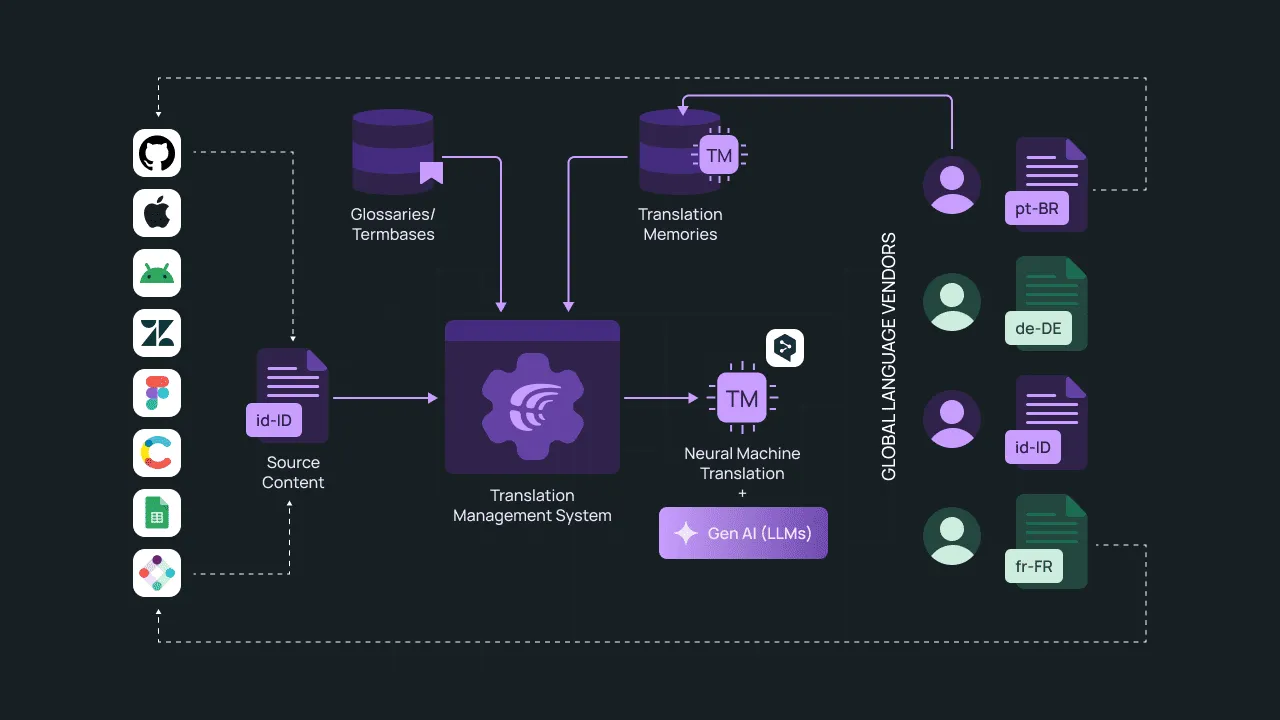
By using Crowdin as the central hub and connectors to Figma, GitHub, Contentful, Intercom, Iterable, Kevel, Strapi, and Intento + DeepL for MT translation, Strava achieved the impossible.
- The entire globalization department and tech stack were built in just 6 weeks.
- Runna was localized into Dutch, French, German, Italian, Japanese, Portuguese, and Spanish.
- By using NMT and LLMs via Crowdin, Strava can now translate faster, better, and cheaper.
"Strava’s experience in localization helped us bring this all to life and their support has been instrumental in bringing this update to market at pace and at scale,
said Runna’s CEO, Dom Maskel, on Forbes.
"This means millions more runners worldwide can fully experience what we’ve built. This is about more than translation: it’s about inclusivity, accessibility and global ambition to make running more accessible, effective and enjoyable for everyone.
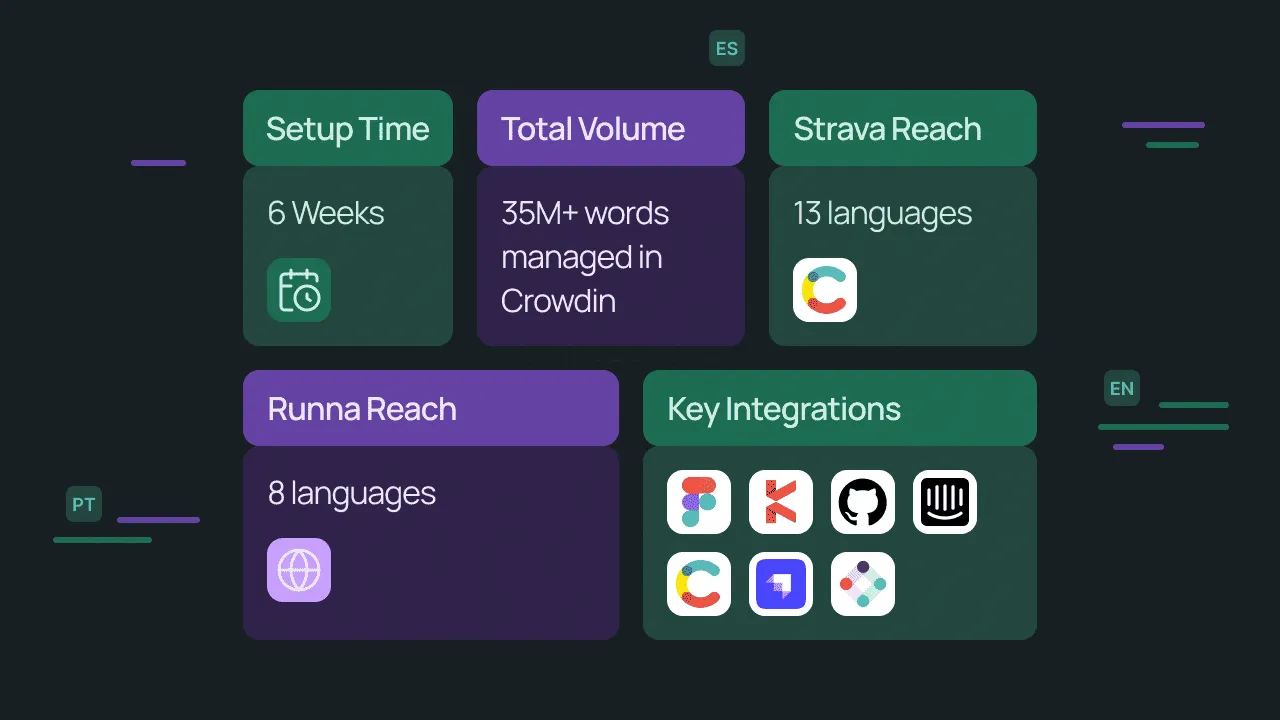
Key Numbers
| SUMMARY | |
|---|---|
| Setup Time | 6 Weeks |
| Total Volume | 35M+ words managed in Crowdin |
| Strava Reach | 13 languages |
| Runna Reach | 8 languages |
| Key Integrations | Figma, GitHub, Contentful, Intercom, Iterable, Kevel, and Strapi |
"None of this would have happened without Crowdin,” says Eduardo. “I think that’s the most powerful sentence I could tell you.
Build Your Own Globalization Strategy
Strava’s journey proves that you don’t need years to go global. With the right technology, you can build a localization strategy in a matter of weeks.
Localize your product with Crowdin

Yuliia Makarenko
Yuliia Makarenko is a marketing specialist with over a decade of experience, and she’s all about creating content that readers will love. She’s a pro at using her skills in SEO, research, and data analysis to write useful content. When she’s not diving into content creation, you can find her reading a good thriller, practicing some yoga, or simply enjoying playtime with her little one.